
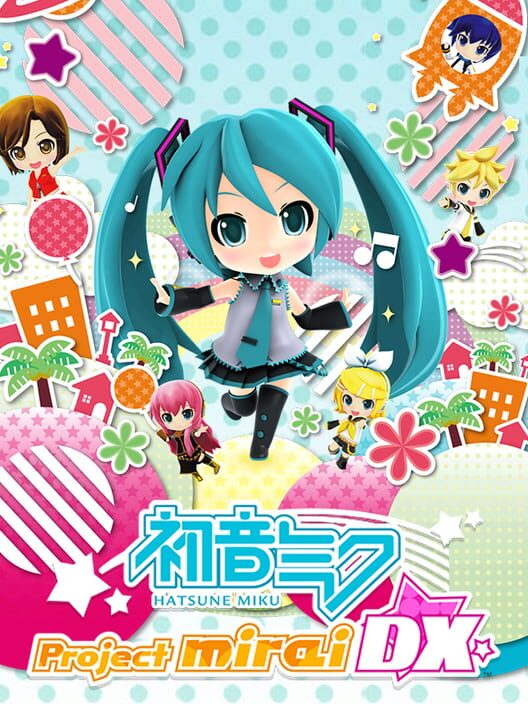
Hatsune Miku: Project Mirai DX is a rhythm game and the sequel to Hatsune Miku and Future Stars: Project Mirai. The game is also a spin-off of the Hatsune Miku: Project DIVA series of Vocaloid rhythm games. Like the original, the game primarily makes use of Vocaloids, a series of singing synthesizer software and the songs created using these vocaloids, most notably the virtual-diva Vocaloid Hatsune Miku. While Project Mirai only had button controls, Project Mirai 2 adds the use of touch screen controls where players tap the bottom screen. An increased sense of speed and additional gimmicks have also been added. The "PuyoPuyo 39" mini-game can be played by two people through a local wireless connection.
IGDB / 10091
Hatsune Miku: Project Mirai DX
Hatsune Miku: Project Mirai DX is a rhythm game and the sequel to Hatsune Miku and Future Stars: Project Mirai. The game is also a spin-off of the Hatsune Miku: Project DIVA series of Vocaloid rhythm games. Like the original, the game primarily makes use of Vocaloids, a series of singing synthesizer software and the songs created using these vocaloids, most notably the virtual-diva Vocaloid Hatsune Miku. While Projec Show full summary
Hatsune Miku: Project Mirai DX is a rhythm game and the sequel to Hatsune Miku and Future Stars: Project Mirai. The game is also a spin-off of the Hatsune Miku: Project DIVA series of Vocaloid rhythm games. Like the original, the game primarily makes use of Vocaloids, a series of singing synthesizer software and the songs created using these vocaloids, most notably the virtual-diva Vocaloid Hatsune Miku. While Project Mirai only had button controls, Project Mirai 2 adds the use of touch screen controls where players tap the bottom screen. An increased sense of speed and additional gimmicks have also been added. The "PuyoPuyo 39" mini-game can be played by two people through a local wireless connection.
World design
Nicht eindeutig
Deep dive / Spielprofil
Everything about Hatsune Miku: Project Mirai DX: story and gameplay
A structured look at the narrative, game feel, and traits that define this game.
8 weitere Tags
Traitanime
Traitaugmented reality
Traitminigames
Traitmusic and rhythm
Traitplay coin support
Traitsinging
Traitspeech synthesis
Traitvocaloid
Media / Screenshots
Hatsune Miku: Project Mirai DX screenshots and game world
Watch / Trailer
Trailer
Trailer metadata from IGDB; playback via YouTube in privacy-enhanced mode.
Game profile / Plain language
Hatsune Miku: Project Mirai DX: release, platforms, and facts
Studio, play style, releases, and official sources — compactly prepared from external IGDB data.
Studios & ownership
Studio & publishing
- Developer
- Sega Games
- Publisher
- Sega Games
- Franchise
- Vocaloid, Hatsune Miku
So spielt es sich
Spielprofil
- Modi
- Single player
- Perspective
- Third person
- Themes
- Nicht angegeben
Wo & wann
Platform releases
- Nintendo 3DS Sep 08, 2015
- Nintendo 3DS Sep 11, 2015
- Nintendo 3DS May 28, 2015
Primärquellen
Official & external links
Prices / Stores
Compare Hatsune Miku: Project Mirai DX prices and deals
Prices never affect your match ranking.
Prices are being updated in the background
Existing results remain visible during the refresh.
No live price for this game yet
The 36 price sources are now being checked in the background. Product prices found will appear automatically.
Shop-Abdeckung
Alle unterstützten Preisquellen
Aktuelle Preise, letzte bekannte Preise und der Prüfstatus jeder Quelle.
EA Store
Preisquelle wird geprüft
Ubisoft Store
Preisquelle wird geprüft
Nintendo eShop
Preisquelle wird geprüft
My Nintendo Store
Preisquelle wird geprüft
Amazon
Preisquelle wird geprüft
DLGamer
Preisquelle wird geprüft
Nuuvem
Preisquelle wird geprüft
Loaded
Preisquelle wird geprüft
Eneba
Preisquelle wird geprüft
G2A
Preisquelle wird geprüft
Kinguin
Preisquelle wird geprüft
K4G
Preisquelle wird geprüft
GAMIVO
Preisquelle wird geprüft
Instant Gaming
Preisquelle wird geprüft
MMOGA
Preisquelle wird geprüft
Royal CD Keys
Preisquelle wird geprüft
GAMESEAL
Preisquelle wird geprüft
GameBoost
Preisquelle wird geprüft
Official storefronts
Check the official platform
Keys, retail & physical editions
More relevant stores
Search more stores for the selected game.
Loaded
Digital Key · Shop-Suche
Eneba
Digital Key · Shop-Suche
G2A
Digital Key · Shop-Suche
Kinguin
Digital Key · Shop-Suche
K4G
Digital Key · Shop-Suche
GAMIVO
Digital Key · Shop-Suche
Instant Gaming
Digital Key · Shop-Suche
MMOGA
Digital Key · Shop-Suche
Royal CD Keys
Digital Key · Shop-Suche
GAMESEAL
Digital Key · Shop-Suche
GameBoost
Digital Key · Shop-Suche
Physical & partner search