
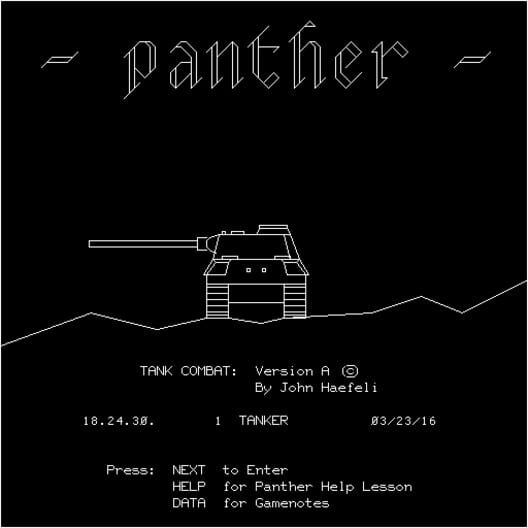
Panther Cover

IGDB / 291106

Panther

1975 Simulator
Panther, a battle tank-driving simulation named after the Panther tank, was one of a handful of early first-person computer games developed by John Edo Haefeli and Nelson Bridwell in 1975 at Northwestern University. The game was developed for the multi-user interactive computer-based education PLATO system and programmed in the TUTOR programming language and utilized scalable vector graphics called linesets. A 1977 d Show full summary

Panther, a battle tank-driving simulation named after the Panther tank, was one of a handful of early first-person computer games developed by John Edo Haefeli and Nelson Bridwell in 1975 at Northwestern University. The game was developed for the multi-user interactive computer-based education PLATO system and programmed in the TUTOR programming language and utilized scalable vector graphics called linesets. A 1977 development of Panther, with more refined graphics, was named Panzer. The game features team-based deathmatch. There are two teams, Squares and Triangles. The object of the game is to destroy the opposing team's base. Game play is straightforward; the player selects a pseudonym and a team, traverse the terrain looking for enemies to destroy on the way to their base. Perspective is maintained by the use of scalable vector graphics and visual interest is enhanced with special graphics for explosions using a custom character set to accomplish limited raster graphics animation. When players enter the game their tanks are placed randomly in the playing arena near their bases and are temporarily camouflaged to allow time to orient themselves with the current map and state of play. The initial view of the game is in "on-board" mode, which is a first-person perspective of the arena. The other main view available is the map which shows the 5 mountains (Crag, Nixon, Og, Pathos, and Red) which vary in size and placement each time a new game is started. On the map view players can see all of their team members positions and can see enemies only when they are within range. Messaging between team members is available and broadcast-style messages (insults) to the opposing team are also allowed. Team coordination and cooperation is critical to winning in this game as each player has different skills, some players are better at hunting down and killing enemies (or at least engaging and distracting them), others are good at hiding and sneaking to the opposing base to begin bombardment. An interesting capability of the game is that players can donate ammunition and fuel to other players in order to facilitate their role in the game. Ammunition and fuel are loaded at the player's base.

World design Nicht eindeutig Game modeMultiplayer

Deep dive / Spielprofil

Everything about Panther: story and gameplay

A structured look at the narrative, game feel, and traits that define this game.

Story & context
Panther, a battle tank-driving simulation named after the Panther tank, was one of a handful of early first-person computer games developed by John Edo Haefeli and Nelson Bridwell in 1975 at Northwestern University. The game was developed for the multi-user interactive computer-based education PLATO system and programmed in the TUTOR programming language and utilized scalable vector graphics called linesets. A 1977 development of Panther, with more refined graphics, was named Panzer. The game features team-based deathmatch. There are two teams, Squares and Triangles. The object of the game is to destroy the opposing team's base. Game play is straightforward; the player selects a pseudonym and a team, traverse the terrain looking for enemies to destroy on the way to their base. Perspective is maintained by the use of scalable vector graphics and visual interest is enhanced with special g Show full description

Panther, a battle tank-driving simulation named after the Panther tank, was one of a handful of early first-person computer games developed by John Edo Haefeli and Nelson Bridwell in 1975 at Northwestern University. The game was developed for the multi-user interactive computer-based education PLATO system and programmed in the TUTOR programming language and utilized scalable vector graphics called linesets. A 1977 development of Panther, with more refined graphics, was named Panzer. The game features team-based deathmatch. There are two teams, Squares and Triangles. The object of the game is to destroy the opposing team's base. Game play is straightforward; the player selects a pseudonym and a team, traverse the terrain looking for enemies to destroy on the way to their base. Perspective is maintained by the use of scalable vector graphics and visual interest is enhanced with special graphics for explosions using a custom character set to accomplish limited raster graphics animation. When players enter the game their tanks are placed randomly in the playing arena near their bases and are temporarily camouflaged to allow time to orient themselves with the current map and state of play. The initial view of the game is in "on-board" mode, which is a first-person perspective of the arena. The other main view available is the map which shows the 5 mountains (Crag, Nixon, Og, Pathos, and Red) which vary in size and placement each time a new game is started. On the map view players can see all of their team members positions and can see enemies only when they are within range. Messaging between team members is available and broadcast-style messages (insults) to the opposing team are also allowed. Team coordination and cooperation is critical to winning in this game as each player has different skills, some players are better at hunting down and killing enemies (or at least engaging and distracting them), others are good at hiding and sneaking to the opposing base to begin bombardment. An interesting capability of the game is that players can donate ammunition and fuel to other players in order to facilitate their role in the game. Ammunition and fuel are loaded at the player's base.

Game profile / Plain language

Panther: release, platforms, and facts

Studio, play style, releases, and official sources — compactly prepared from external IGDB data.

01
Studios & ownership

Studio & publishing

Developer
Nicht angegeben
Publisher
Nicht angegeben
Franchise
Standalone
02
So spielt es sich

Spielprofil

Modi
Multiplayer
Perspective
First person
Themes
Warfare
03
Wo & wann

Platform releases

  • PLATO Dec 31, 1975

Prices / Stores

Compare Panther prices and deals

Prices never affect your match ranking.

No live price for this game yet

The 36 price sources are now being checked in the background. Product prices found will appear automatically.

Official storefronts

Check the official platform

1 / 2