
Strider is set in a dystopian future in the year 2048, where a mysterious dictator known as the "Grandmaster" rules over the world. Hiryu, the youngest ever Super A Ranked[2] member of an organization of high-tech ninja-like agents known as the "Striders", is alone tasked with the Grandmaster's assassination. Hiryu begins his mission by infiltrating the Grandmaster's capital at the Kazakh Soviet Socialist Republic.
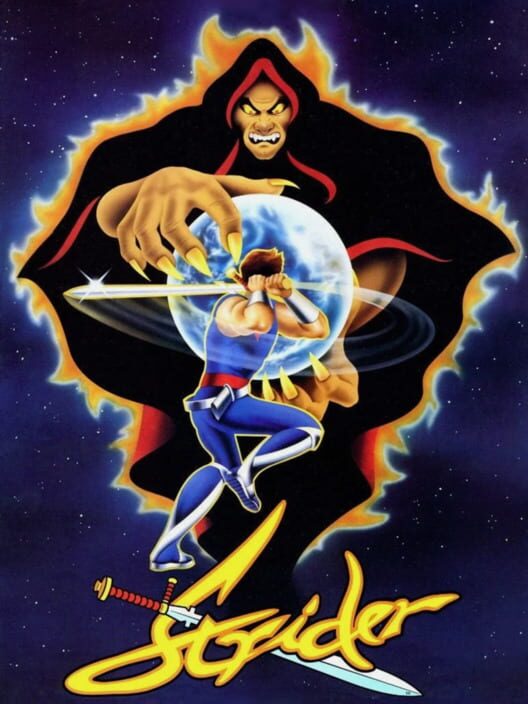
IGDB / 6969
Strider
The controls of Strider consist of an eight-way joystick and two action buttons for attacking and jumping. The player controls Hiryu himself, whose main weapon is a tonfa-like plasma sword known as "Cypher". He can perform numerous acrobatic feats depending on the joystick/button combination used. Pressing the jump button while Hiryu is standing still will cause him to do a regular vertical jump, while pressing the j Show full summary
The controls of Strider consist of an eight-way joystick and two action buttons for attacking and jumping. The player controls Hiryu himself, whose main weapon is a tonfa-like plasma sword known as "Cypher". He can perform numerous acrobatic feats depending on the joystick/button combination used. Pressing the jump button while Hiryu is standing still will cause him to do a regular vertical jump, while pressing the jump button while pushing the joystick left or right will enable him to do a cartwheel jump. Hiryu can also slide under or through certain obstacles and enemies by first crouching down and then pressing the jump button. As well as his sliding move, both jumps can also be used to destroy weaker opponents. Hiryu is able to latch onto certain platforms, and climb across walls and ceilings using a metallic hook. While running down a sloped surface, Hiryu can gain enough momentum to allow him to do a longer cartwheel jump than usual. Numerous power-ups can be obtained from item boxes carried by certain enemies. These includes an extension to Hiryu's attack range that lasts for one hundred slashes, two types of health aids (represented by the kanji used to write Hiryu's name: 飛 and 飛竜), a max health extension (represented by the kanji 竜, the second character in Hiryu's name), an extra life, and a power-up that not only makes Hiryu invulnerable to attack but also increases his own attack abilities via shadow images of himself for 15 seconds.[3] Hiryu can also summon robotic companions known collectively as "options" that help him fight enemies. These consist of up to two mushroom-like droids, a saber-toothed tiger and a hawk, known individually as Option A, B and C respectively. The game has five stages: the Kazakh Soviet Socialist Republic (called "St. Petersburg" during the arcade game's attract sequence), the Siberian Wilderness, the Aerial Battleship Balrog (געלראב), the Amazonian Jungle, and the Grandmaster's lair itself, the Third Moon. Each of the stages is divided into a number of smaller sections, each with their own time limit and checkpoint location. The player has a three-point health gauge (which can be increased to five points with the health extensions. Hiryu will lose a life when either his health gauge is fully depleted, by moving him off the screen entirely (like falling into a bottomless pit) or when the game's timer reaches zero. It's Game Over when all of Hiryu's lives are lost, but the player can be given the opportunity to continue.
World design
Nicht eindeutig
Game modeMultiplayer
Deep dive / Spielprofil
Everything about Strider: story and gameplay
A structured look at the narrative, game feel, and traits that define this game.
3 weitere Tags
Traitnintendo switch online - expansion pack
Traitwii u virtual console
Traitwii virtual console
Media / Screenshots
Strider screenshots and game world
Watch / Trailer
Gameplay video
Trailer metadata from IGDB; playback via YouTube in privacy-enhanced mode.
Game profile / Plain language
Strider: release, platforms, and facts
Studio, play style, releases, and official sources — compactly prepared from external IGDB data.
Studios & ownership
Studio & publishing
- Developer
- Capcom, Capcom
- Publisher
- Capcom, U.S. Gold, Sega Enterprises, Ltd., Tec Toy
- Franchise
- Strider
So spielt es sich
Spielprofil
- Modi
- Multiplayer, Single player
- Perspective
- Side view
- Themes
- Action, Science fiction
Wo & wann
Platform releases
- ZX Spectrum 1989
- Wii U Nov 18, 2012
- Wii Feb 16, 2012
- Arcade Mar 01, 1989
- DOS 1989
- Commodore C64/128/MAX 1989
- Sega Mega Drive/Genesis 1991
- PlayStation Jul 26, 2000
- Sega Mega Drive/Genesis Jan 01, 2000
- Amiga 1989
- Sega Master System/Mark III 1991
- Sega Mega Drive/Genesis Sep 29, 1990
- Atari ST/STE 1989
- Amstrad CPC 1989
- Sharp X68000 Nov 27, 1992
Primärquellen
Official & external links
Prices / Stores
Compare Strider prices and deals
Prices never affect your match ranking.
Prices are being updated in the background
Existing results remain visible during the refresh.
No live price for this game yet
The 36 price sources are now being checked in the background. Product prices found will appear automatically.
Shop-Abdeckung
Alle unterstützten Preisquellen
Aktuelle Preise, letzte bekannte Preise und der Prüfstatus jeder Quelle.
Steam
Preisquelle wird geprüft
Epic Games Store
Preisquelle wird geprüft
GOG
Preisquelle wird geprüft
EA Store
Preisquelle wird geprüft
Ubisoft Store
Preisquelle wird geprüft
Battle.net Shop
Preisquelle wird geprüft
Rockstar Store
Preisquelle wird geprüft
Meta Quest Store
Preisquelle wird geprüft
itch.io
Preisquelle wird geprüft
PlayStation Store
Preisquelle wird geprüft
Nintendo eShop
Preisquelle wird geprüft
Microsoft Store
Preisquelle wird geprüft
PlayStation Direct
Preisquelle wird geprüft
My Nintendo Store
Preisquelle wird geprüft
Amazon
Preisquelle wird geprüft
Humble Store
Preisquelle wird geprüft
IndieGala Store
Preisquelle wird geprüft
DLGamer
Preisquelle wird geprüft
GameBillet
Preisquelle wird geprüft
Voidu
Preisquelle wird geprüft
Nuuvem
Preisquelle wird geprüft
Fanatical
Preisquelle wird geprüft
Loaded
Preisquelle wird geprüft
Eneba
Preisquelle wird geprüft
G2A
Preisquelle wird geprüft
Kinguin
Preisquelle wird geprüft
K4G
Preisquelle wird geprüft
GAMIVO
Preisquelle wird geprüft
2Game
Preisquelle wird geprüft
GamersGate
Preisquelle wird geprüft
Gamesplanet
Preisquelle wird geprüft
Instant Gaming
Preisquelle wird geprüft
MMOGA
Preisquelle wird geprüft
Royal CD Keys
Preisquelle wird geprüft
GAMESEAL
Preisquelle wird geprüft
YUPLAY
Preisquelle wird geprüft
GameBoost
Preisquelle wird geprüft
Official storefronts
Check the official platform
Steam
Digital · PC · Preis im Originalshop prüfen
Epic Games Store
Digital · PC · Preis im Originalshop prüfen
GOG
Digital · PC · Preis im Originalshop prüfen
EA Store
Digital · EA app · Preis im Originalshop prüfen
Ubisoft Store
Digital · Ubisoft Connect · Preis im Originalshop prüfen
Battle.net Shop
Digital · Battle.net · Preis im Originalshop prüfen
Rockstar Store
Digital · Rockstar Launcher · Preis im Originalshop prüfen
Meta Quest Store
Digital · VR · Preis im Originalshop prüfen
itch.io
Digital · PC · Preis im Originalshop prüfen
PlayStation Store
Digital · PlayStation · Preis im Originalshop prüfen
Nintendo eShop
Digital · Nintendo · Preis im Originalshop prüfen
Microsoft Store
Digital · Windows & Xbox · Preis im Originalshop prüfen
PlayStation Direct
Physisch · PlayStation · Preis im Originalshop prüfen
My Nintendo Store
Physisch & Digital · Nintendo · Preis im Originalshop prüfen
Keys, retail & physical editions
More relevant stores
Search more stores for the selected game.
Humble Store
Digital Key · PC · Shop-Suche
IndieGala Store
Digital Key · PC · Shop-Suche
DLGamer
Digital Key · PC, Xbox & Nintendo · Shop-Suche
GameBillet
Digital Key · PC · Shop-Suche
Voidu
Digital Key · PC · Shop-Suche
Nuuvem
Digital Key · Shop-Suche
Fanatical
Digital Key · PC · Shop-Suche
2Game
Digital Key · PC · Shop-Suche
GamersGate
Digital Key · PC · Shop-Suche
Gamesplanet
Digital Key · PC · Shop-Suche
Loaded
Digital Key · Shop-Suche
Eneba
Digital Key · Shop-Suche
G2A
Digital Key · Shop-Suche
Kinguin
Digital Key · Shop-Suche
K4G
Digital Key · Shop-Suche
GAMIVO
Digital Key · Shop-Suche
Instant Gaming
Digital Key · Shop-Suche
MMOGA
Digital Key · Shop-Suche
Royal CD Keys
Digital Key · Shop-Suche
GAMESEAL
Digital Key · Shop-Suche
YUPLAY
Digital Key · Shop-Suche
GameBoost
Digital Key · Shop-Suche
Physical & partner search
Search by edition and platform
Amiga
Physical store search
ACPC
Physical store search
Arcade
Physical store search
Atari-ST
Physical store search
C64
Physical store search
DOS
Physical store search
PS1
Physical store search
SMS
Physical store search
Genesis/MegaDrive
Physical store search
Sharp X68000
Physical store search
Wii
Physical store search
WiiU
Physical store search
ZXS
Physical store search