
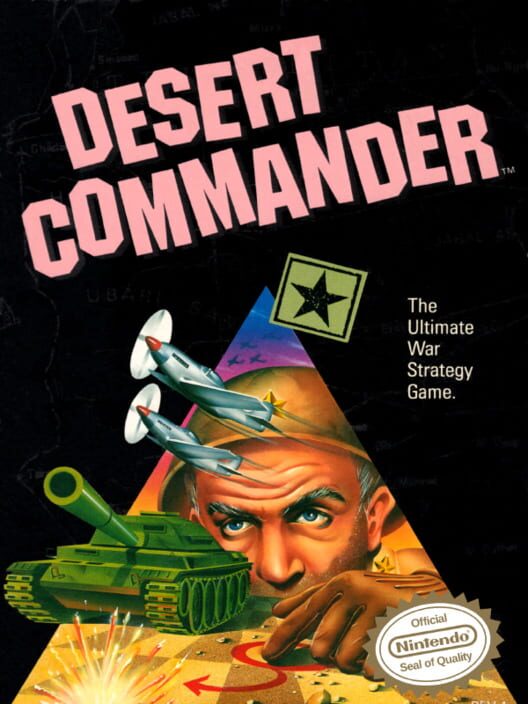
Desert Commander Cover

IGDB / 48137

Desert Commander

1988 Strategy Turn-based strategy (TBS)
The player's force consists of nine different types of units and one headquarters unit (which is a unit by itself and also can be used to attack). Each scenario gives a different set number of units to use, which the player can mix and match between the different typese without going over that limit. When in a one-player game, the second controller can be used to modify the CPU forces. When playing against the CPU, t Vollständige Kurzbeschreibung anzeigen

The player's force consists of nine different types of units and one headquarters unit (which is a unit by itself and also can be used to attack). Each scenario gives a different set number of units to use, which the player can mix and match between the different typese without going over that limit. When in a one-player game, the second controller can be used to modify the CPU forces. When playing against the CPU, the computer will be given a different ratio of units to command than the player. On the easiest scenario both the player and the CPU have the same amount of units, on all others the CPU will have more than the player. There is no variance in artificial intelligence, so the only thing that makes the later maps harder is the larger number of units the CPU has. The game is turn-based with no time limit. The object of the game is to destroy the enemy's headquarters unit. The player that does so first wins. Units have different mobility range, which varies according to the unit type and (except for aircraft) the terrain. They also have different shooting range, though this is fixed and not depends of the terrain. All unit types have limited ammunition and fuel. In order to replenish them the player must land them at the appropiate buildings; for example, all aircraft must stop at an airport in order to recharge their fuel and ammo supply. A certain unit is particularly strong or weak against a particular opponent, performing average against every other unit types.

Weltdesign Nicht eindeutig GameplayKampf-fokussiert SpielmodusMultiplayer

Detailanalyse / Spielprofil

Alles über Desert Commander: Story und Spielprinzip

Ein strukturierter Blick auf Erzählung, Spielgefühl und die Eigenschaften, die dieses Spiel definieren.

Story & Kontext
The player's force consists of nine different types of units and one headquarters unit (which is a unit by itself and also can be used to attack). Each scenario gives a different set number of units to use, which the player can mix and match between the different typese without going over that limit. When in a one-player game, the second controller can be used to modify the CPU forces. When playing against the CPU, the computer will be given a different ratio of units to command than the player. On the easiest scenario both the player and the CPU have the same amount of units, on all others the CPU will have more than the player. There is no variance in artificial intelligence, so the only thing that makes the later maps harder is the larger number of units the CPU has. The game is turn-based with no time limit. The object of the game is to destroy the enemy's headquarters unit. The play Vollständige Beschreibung anzeigen

The player's force consists of nine different types of units and one headquarters unit (which is a unit by itself and also can be used to attack). Each scenario gives a different set number of units to use, which the player can mix and match between the different typese without going over that limit. When in a one-player game, the second controller can be used to modify the CPU forces. When playing against the CPU, the computer will be given a different ratio of units to command than the player. On the easiest scenario both the player and the CPU have the same amount of units, on all others the CPU will have more than the player. There is no variance in artificial intelligence, so the only thing that makes the later maps harder is the larger number of units the CPU has. The game is turn-based with no time limit. The object of the game is to destroy the enemy's headquarters unit. The player that does so first wins. Units have different mobility range, which varies according to the unit type and (except for aircraft) the terrain. They also have different shooting range, though this is fixed and not depends of the terrain. All unit types have limited ammunition and fuel. In order to replenish them the player must land them at the appropiate buildings; for example, all aircraft must stop at an airport in order to recharge their fuel and ammo supply. A certain unit is particularly strong or weak against a particular opponent, performing average against every other unit types.

4 weitere Tags
Merkmalmodern military Merkmalmodern warfare Merkmalrock paper scissors Merkmaltactical turn-based combat

Spielprofil / Klartext

Desert Commander: Release, Plattformen und Fakten

Studio, Spielweise, Veröffentlichungen und offizielle Quellen – kompakt aus den externen IGDB-Daten aufbereitet.

01
Studios & Rechte

Studio & Veröffentlichung

Entwickler
Kotobuki Systems
Herausgeber
Kotobuki Systems
Franchise
Eigenständig
02
So spielt es sich

Spielprofil

Modi
Multiplayer, Single player
Perspektive
Bird view / Isometric
Themen
Action, Historical, Warfare
03
Wo & wann

Plattform-Veröffentlichungen

  • Family Computer Apr 28, 1988
  • Nintendo Entertainment System Jun 1989

Preise / Shops

Desert Commander Preise und Angebote vergleichen

Preise beeinflussen niemals die Trefferrangfolge.

Physische Shop-Suche

Edition und Plattform gezielt suchen