
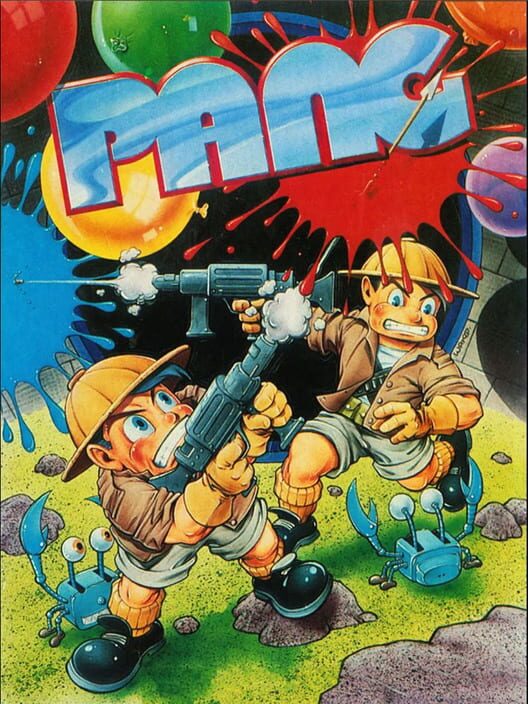
Buster Bros. Cover

IGDB / 6823

Buster Bros.

1989 76 / 100 Arcade Plattform Shooter
Pang, originally released in Japan as Pomping World and in North America as Buster Bros., is a 1989 arcade action game developed by Mitchell Corporation. Its core gameplay is similar to the 1983 Japanese MSX game Cannon Ball, also released that year for the ZX Spectrum as Bubble Buster. Players embark on a round-the-world quest to destroy bouncing balloons that are threatening landmarks and cities across the globe. Vollständige Kurzbeschreibung anzeigen

Pang, originally released in Japan as Pomping World and in North America as Buster Bros., is a 1989 arcade action game developed by Mitchell Corporation. Its core gameplay is similar to the 1983 Japanese MSX game Cannon Ball, also released that year for the ZX Spectrum as Bubble Buster. Players embark on a round-the-world quest to destroy bouncing balloons that are threatening landmarks and cities across the globe. The game features 50 stages set in 17 locations, including Mt. Fuji, Mt. Keirin, the Temple of the Emerald Buddha, Angkor Wat, Ayers Rock, the Taj Mahal, Leningrad, Paris, London, Barcelona, Athens, Egypt, Kenya, New York, Maya ruins, Antarctica, and Easter Island. Later versions added additional locations. Each stage includes a background depicting local landmarks, along with a unique arrangement of blocks, some destructible, some permanent, and some hidden with bonus items. Stages begin with balloons of various sizes; the largest balloons split into smaller ones three times before disappearing after the fourth hit. Players start with a single harpoon, though special weapons can drop when balloons are popped. At certain points, food items worth bonus points may also appear. Contact with any balloon results in the loss of a life. In two-player mode, if both players touch a balloon at the same time, only Player 1 loses a life. Similarly, when both reach a bonus or weapon simultaneously, only Player 1 collects it. Players begin with three to five lives depending on dip switch settings, with extra lives awarded upon reaching specific score thresholds. A stage is cleared when all balloons are destroyed, and the game concludes after all stages are completed, ending with the heroes driving their jeep into the sunset on an Easter Island beach.

Weltdesign Nicht eindeutig GameplayKampf-fokussiert SpielmodusKoop SpielmodusMultiplayer

Detailanalyse / Spielprofil

Alles über Buster Bros.: Story und Spielprinzip

Ein strukturierter Blick auf Erzählung, Spielgefühl und die Eigenschaften, die dieses Spiel definieren.

Story & Kontext
Pang, originally released in Japan as Pomping World and in North America as Buster Bros., is a 1989 arcade action game developed by Mitchell Corporation. Its core gameplay is similar to the 1983 Japanese MSX game Cannon Ball, also released that year for the ZX Spectrum as Bubble Buster. Players embark on a round-the-world quest to destroy bouncing balloons that are threatening landmarks and cities across the globe. The game features 50 stages set in 17 locations, including Mt. Fuji, Mt. Keirin, the Temple of the Emerald Buddha, Angkor Wat, Ayers Rock, the Taj Mahal, Leningrad, Paris, London, Barcelona, Athens, Egypt, Kenya, New York, Maya ruins, Antarctica, and Easter Island. Later versions added additional locations. Each stage includes a background depicting local landmarks, along with a unique arrangement of blocks, some destructible, some permanent, and some hidden with bonus items. Vollständige Beschreibung anzeigen

Pang, originally released in Japan as Pomping World and in North America as Buster Bros., is a 1989 arcade action game developed by Mitchell Corporation. Its core gameplay is similar to the 1983 Japanese MSX game Cannon Ball, also released that year for the ZX Spectrum as Bubble Buster. Players embark on a round-the-world quest to destroy bouncing balloons that are threatening landmarks and cities across the globe. The game features 50 stages set in 17 locations, including Mt. Fuji, Mt. Keirin, the Temple of the Emerald Buddha, Angkor Wat, Ayers Rock, the Taj Mahal, Leningrad, Paris, London, Barcelona, Athens, Egypt, Kenya, New York, Maya ruins, Antarctica, and Easter Island. Later versions added additional locations. Each stage includes a background depicting local landmarks, along with a unique arrangement of blocks, some destructible, some permanent, and some hidden with bonus items. Stages begin with balloons of various sizes; the largest balloons split into smaller ones three times before disappearing after the fourth hit. Players start with a single harpoon, though special weapons can drop when balloons are popped. At certain points, food items worth bonus points may also appear. Contact with any balloon results in the loss of a life. In two-player mode, if both players touch a balloon at the same time, only Player 1 loses a life. Similarly, when both reach a bonus or weapon simultaneously, only Player 1 collects it. Players begin with three to five lives depending on dip switch settings, with extra lives awarded upon reaching specific score thresholds. A stage is cleared when all balloons are destroyed, and the game concludes after all stages are completed, ending with the heroes driving their jeep into the sunset on an Easter Island beach.

7 weitere Tags
Merkmalanime Merkmalbubbles Merkmalgames released for unsupported platforms Merkmalgrapple Merkmalhigh score Merkmalpixel art Merkmalverticality

Ansehen / Trailer

Gameplay video

Trailer-Metadaten von IGDB, Wiedergabe über YouTube im erweiterten Datenschutzmodus.

Spielprofil / Klartext

Buster Bros.: Release, Plattformen und Fakten

Studio, Spielweise, Veröffentlichungen und offizielle Quellen – kompakt aus den externen IGDB-Daten aufbereitet.

01
Studios & Rechte

Studio & Veröffentlichung

Entwickler
Mitchell Corporation
Herausgeber
Capcom, Ocean Software Ltd., Hudson Soft
Franchise
Eigenständig
02
So spielt es sich

Spielprofil

Modi
Co-operative, Multiplayer, Single player
Perspektive
Side view
Themen
Action
03
Wo & wann

Plattform-Veröffentlichungen

  • DOS 1990
  • Commodore C64/128/MAX 1990
  • Super Nintendo Entertainment System 1989
  • Amstrad CPC 1991
  • ZX Spectrum 1990
  • Atari ST/STE 1990
  • Turbografx-16/PC Engine CD 1993
  • Amiga 1990
  • Arcade Dec 1989
  • Turbografx-16/PC Engine CD 1991
  • Arcade Nov 29, 1989

Preise / Shops

Buster Bros. Preise und Angebote vergleichen

Preise beeinflussen niemals die Trefferrangfolge.

Noch kein Livepreis für dieses Spiel

Die 36 Preisquellen werden jetzt im Hintergrund geprüft. Gefundene Produktpreise erscheinen automatisch.

Shop-Abdeckung

Alle unterstützten Preisquellen

Aktuelle Preise, letzte bekannte Preise und der Prüfstatus jeder Quelle.

1 / 3